
Professional MSGtoEML conversion is useful when Outlook archives need to be converted into a more flexible and accessible email format. Many users store important communication as MSG files, especially when messages were saved directly from Microsoft Outlook. These files can contain valuable business emails, customer conversations, project updates, invoices, support histories, and personal correspondence.
The main advantage of MSGtoEML conversion is that archived Outlook messages can be prepared for broader use. Instead of keeping email data tied to one specific Outlook environment, users can convert messages into EML files for migration, backup, long-term archiving, or import into compatible email clients. This makes the archive easier to manage, especially when older systems are replaced or email software changes.
Convert Outlook MSG Files into Standard EML Format
MSG files are typically connected to Microsoft Outlook, while EML is a standard email file format supported by many mail applications. Converting Outlook MSG files into EML format helps users keep emails readable outside the original Outlook installation. This is important when archived communication must remain available after a system upgrade, software change, or migration to another email client.
A reliable conversion should preserve the key parts of each message. These include the visible email text, sender details, recipients, subject line, date information, and formatting. For business users, this is especially important because an email archive is often used as documentation, proof of communication, or reference material for later decisions.
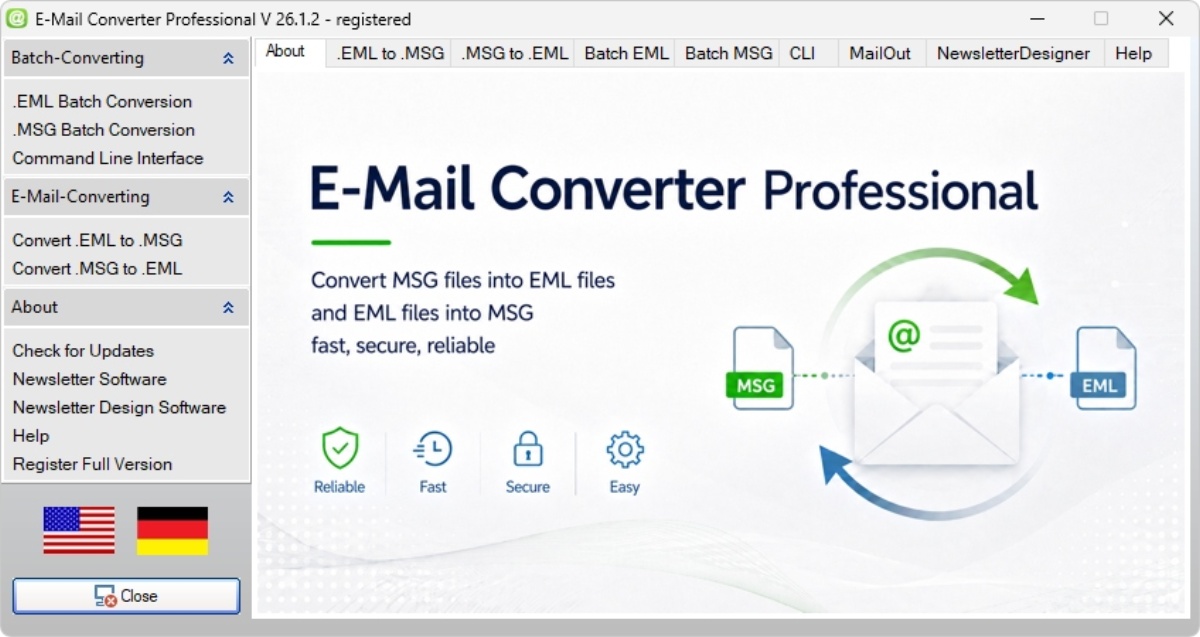
Use E-Mail Converter Professional for Structured Email Export
E-Mail Converter Professional can help users export Outlook MSG files into EML format in a structured way. This is helpful for beginners because the conversion process does not require manually opening every message and saving it again. Instead, users can work with individual files, multiple messages, or complete archive folders depending on the size of the project.
Structured email export is especially useful when archives are already organized by:
- customer or client name
- project, case, or department
- year, month, or reporting period
- invoice, order, or support category
- old user profile, backup folder, or Outlook export directory
When this structure is maintained during export, the converted EML archive remains easier to search, transfer, and store. Users do not have to rebuild the folder logic manually after conversion, which saves time and reduces the risk of misplaced messages.
MSG to EML Converter Methods
Different email conversion projects require different methods. A user who only needs to convert one important message has different requirements than a company that needs to process thousands of Outlook files. A MSG to EML converter should therefore support flexible workflows for small tasks, larger archives, and automated conversion scenarios.
Single Convert for Individual Message Files
Single convert is useful when only one MSG file or a small number of selected messages need to be converted. This method is practical for one-time tasks, test conversions, or individual emails that must be saved in a more portable format. For example, users may want to convert a single contract email, an invoice message, a customer request, or a technical support conversation.
For beginners, single conversion is also the easiest way to understand the process. The user selects a file, converts it, and checks the resulting EML file. If the message body, subject, sender, recipients, date, and formatting are preserved correctly, the same approach can be used for more files or larger folders.
Batch Convert for Multiple MSG Files
Batch convert is designed for larger collections of MSG files. Instead of processing every message manually, users can convert multiple emails in one operation. This is particularly useful for archived Outlook folders, old project communication, customer mail collections, exported message libraries, and business email backups.
Batch conversion is valuable when users need to:
- convert many Outlook MSG files without repetitive manual steps
- prepare larger email archives for migration or backup
- standardize saved messages into one target format
- process old customer, project, or department folders more efficiently
- reduce the time required for Windows or email client migration
A batch workflow makes archive processing faster and more consistent. This is important when many files are involved, because the output should remain organized and predictable across the complete conversion project.
Command-Line-Interface (CLI) for Scripted Conversion
A Command-Line-Interface, often called CLI, is useful for advanced users who want to automate conversion tasks. Instead of starting each conversion manually, scripted conversion can be integrated into technical workflows, scheduled jobs, or administrative processes. This is especially helpful in professional environments where the same type of conversion must be repeated regularly.
CLI-based MSG to EML conversion can support recurring archive preparation, server-side file processing, backup workflows, or standardized migration routines. For IT administrators, this can reduce manual effort and improve consistency across multiple users, departments, or archive locations.
Windows 10 to Windows 11 Email Migration
A Windows 10 to Windows 11 email migration is a common reason to review and convert old Outlook data. Before switching systems, users often discover saved MSG files in backup drives, old desktop folders, exported Outlook directories, or archived user profiles. If these files are not prepared properly, they may become harder to open or organize after the move.
Converting emails into EML format before the system change can make the migration smoother. EML files are easier to store in normal folders, include in backup plans, and use with compatible email clients. This gives users more control over their archived communication after the Windows 11 transition.
Prepare Old Outlook Data Before Switching Systems
Preparing old Outlook data before switching systems helps avoid access problems later. Instead of copying unsorted MSG files to the new computer and checking them afterward, users can organize and convert the archive in advance. This creates a cleaner structure and makes it easier to verify that important messages are still readable.
A practical preparation workflow can include:
- creating a backup of all original MSG files before conversion
- sorting source folders by year, customer, project, topic, or department
- running a small test conversion with selected messages
- checking whether metadata and formatting are preserved
- converting the complete archive only after the sample result is verified
This approach is especially useful for users who want to avoid data loss during a Windows upgrade. It also helps create a cleaner email archive that can be stored, searched, and transferred more easily.
Enable Migration Between Outlook and Other Email Clients
Migration between Outlook and other email clients often requires a file format that the target application can read. Since MSG files are closely linked to Outlook, they are not always convenient for cross-client migration. EML files are more widely supported, which makes MSG to EML conversion useful when users want to move archived messages into another mail environment.
This is not only a technical format change. A good migration process should keep the email content understandable and complete. Sender information, recipient fields, subject lines, dates, message text, and formatting all help preserve the original context of the conversation.
Outlook files are closely tied to a specific environment and cannot always be opened directly in other mail clients. To solve this, you can save MSG files platform-independently by converting them into standard email formats with this MSGtoEml converter. This transition is made simple with dedicated utilities, allowing you to use a standalone EML conversion software or implement an alternative solution to convert Outlook messages to EML while keeping all attachments and metadata intact.
Batch Conversion and Outlook Archive Preparation
Batch conversion and Outlook archive preparation are important when users work with large message collections. Old archives often contain many folders, subfolders, and individual MSG files from different years or projects. Without a structured conversion process, these files can become difficult to manage after migration.
A well-prepared archive saves time later. Users can find older messages faster, keep business communication organized, and store converted files in a format that is easier to reuse. This is particularly valuable for companies, freelancers, support teams, and private users with long-term email records.
Convert Larger Email Archives Efficiently
Larger email archives require an efficient workflow because manual file-by-file conversion can take too much time. Batch processing allows users to convert many messages in one step and helps keep the output consistent. This is useful for old Outlook backups, project folders, department archives, and customer communication records.
Efficient archive conversion also reduces the chance of overlooking individual files. When the source folders are prepared carefully, users can process complete message collections and create a more manageable EML archive for backup, review, or import.
Maintain Complete Folder and Directory Structures
Folder and directory structure support is important when emails are already organized in a meaningful way. A folder named after a customer, project, year, or department gives context to the messages inside it. If this structure is maintained during conversion, the exported archive remains easier to understand. During an email migration, this converter for changing Outlook MSGtoEML can support cleaner transfer of stored correspondence.
This is especially helpful for business documentation. Instead of receiving a single unorganized folder with many converted files, users can keep the original archive logic. That makes it easier to search for specific conversations, review historical communication, and transfer the archive to another storage location.
Preserve Email Content, Formatting and Key Metadata
Preserving email content, formatting, and metadata is essential for reliable conversion. The visible message text alone is not enough. Users also need sender details, recipient information, subject lines, timestamps, and formatting to understand the full meaning of each email.
Formatting can include signatures, line breaks, quoted replies, tables, and structured business information. If these elements remain intact, the converted archive is easier to read and more useful for daily work, audits, support research, legal documentation, and long-term storage. This makes a professional conversion workflow valuable far beyond simple file export.